
Understanding audio capture for interview settings
Microphone types overview
In a room where a single breath can carry a career, understanding audio capture transforms questions into conversation. An interview microphone isn’t about flashy gear; it’s about clarity, proximity, and character. Subtleties in room acoustics and mic distance shape the story you tell, whether you’re in a bustling studio in Johannesburg or a quiet corner set in Cape Town. I’ve learned that the small moments between questions are where the truth lands!
Here are microphone types that frequently shape interview sound:
- Dynamic handheld mics for controlled, close-range voices
- Lavalier (lapel) mics that move with the speaker
- Shotgun or short shotgun mics to trim ambient noise
- Boundary mics suited to table setups
Choosing the right type hinges on context, room, and the talent’s comfort. When the sound glides with the moment, the interview feels less like a recording and more like a shared memory.
Polar patterns and their impact on interviews
Sixty percent of interview moments crumble not from questions but from mis-matched polar patterns. Understanding audio capture in interview settings is the quiet craft that turns a whispered answer into a memory you want to replay in a Johannesburg studio or a Cape Town corner. The right alignment lets the voice carry the scene, not the air between words.
Polar patterns shape who hears what. For the interview microphone, cardioid focuses on the speaker’s mouth while minimizing distant chatter; omnidirectional gathers room ambience; bidirectional catches the edges when two voices share the frame.
- Cardioid: front focus, less room noise
- Omnidirectional: full-room mood
- Bidirectional: two-speaker intimacy
These patterns remind us that the soundscape is less about gadgets and more about listening, position, and trust with the interview microphone.
Audio interfaces and preamps basics
Understanding audio capture for interview settings isn’t glamorous, but it’s the quiet force behind every memorable moment. The chain from mouth to monitor decides whether a whisper lands with clarity or dissolves into the room. In the studio and on location, the right signal path is a kind of unseen conductor, and the interview microphone is only the first note in its long, patient song.
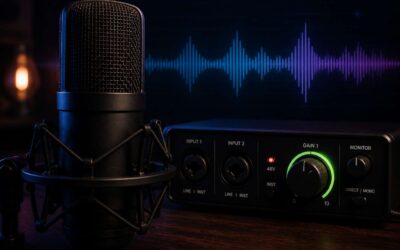
Audio interfaces and preamps basics shape that conductor’s tone. They translate the microphone’s tiny voltages into something a recorder can hold, add clean gain, and preserve the voice’s presence without inviting artefacts or hiss.
- Gain staging and headroom prevent distortion
- Phantom power powers condensers when needed
- Impedance matching preserves detail across distances
That balance of gear and listening is what keeps voices front and center, even when the room tries to tell another story.
Key specs to watch
Two seconds is all it takes for a listener to decide if a voice is clear enough to stay in the moment. In interview microphone work, clarity is the currency—your breath and cadence travel from mic to memory.
Understanding audio capture for interview settings means tracing the thread from voice to recorder: the mic’s character, how it sits with the speaker, the room’s personality, and a path that preserves presence without inviting rumble or hiss.
Key specs to watch form a compass for your choice:
- Signal-to-noise ratio and self-noise
- Frequency response that flatters speech
- Phantom power compatibility
With these considerations, the interview microphone becomes a trusted ally for on-location storytelling across SA studios and streets.
0 Comments